German Of The Day: Flaschenhals

That means bottleneck.

Flashenhals

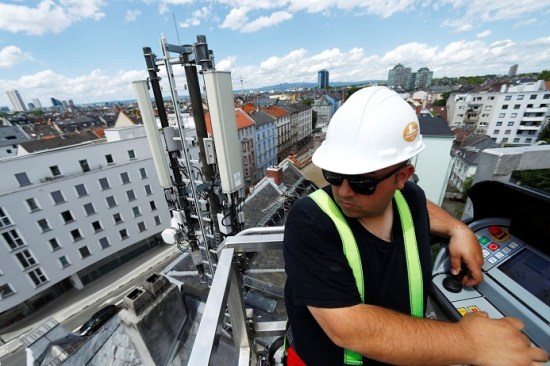
Germany is looking for new ways to power its economy as the traditional growth engines of manufacturing and exports falter. But the country’s outdated internet is acting as a bottleneck.

The sorry state of the online network has become a national joke and an economic liability. Germany ranks 33rd in the world in average monthly fixed broadband connection speeds, and 47th for mobile, according to Speedtest Global Index.

“It’s too slow. If you’re really world class in production, having a ranking of, say, [33rd] in working internet does not fit together with that image.”

A Meating Of Minds

Meat

President Donald Trump just announced a new deal under which the EU will accept a high number of American beef exports, a move that will surely increase profits for US farmers and related industries. The EU will accept 45,000 tons of hormone-free beef from foreign countries every year, and America will be allowed to fulfill 35,000 tons of that quota after seven years — roughly 80 percent of the total.

“America has great beef. We’re selling more.”

German Of The Day: Freier Fall

That means freefall.

Freefall

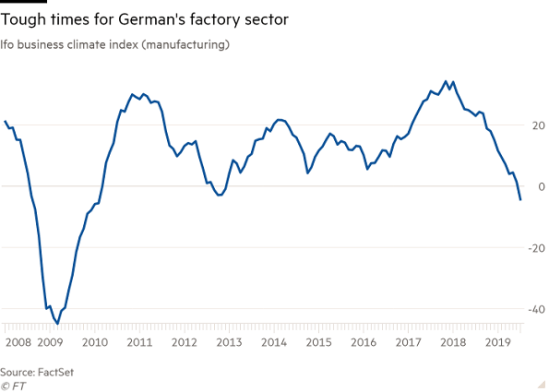
German manufacturing reports industry ‘in freefall’ – Key survey points to weakest sentiment in nine years.

The Ifo Institute’s manufacturing business climate index slumped to minus 4.3 in July from positive 1.3 the previous month. The reading was the lowest in more than nine years and echoes a separate survey released on Wednesday that pointed to mounting troubles in Europe’s powerhouse economy.

“No improvement is expected in the short term, as businesses are looking ahead to the next six months with more pessimism.”

Saving The Planet The Convenient Way

Lord knows that “saving the planet” from climate change is hard work.

Planet

That is why so many Germans are so “conscientious about the purchases they make, ride bikes and try to reduce their trash and carbon footprint.” They are also perfectly aware of the fact that they “can’t solve the problem on their own,” which us very, well, convenient but “they can force politicians and businesses to act,” which they do, if it isn’t all too inconvenient, that is.

And all of this gives them a good conscience, which is good. A good conscience one must have when one is riddled with guilt. A good conscience one must have when one is driving one’s expensive German non-electric automobile down the autobahn at excessive speeds, for example, or purchasing goods and products grown or manufactured on the other side of the planet being saved and flown in to Germany at dumping prices. A good conscience one must have when one simultaneously exports one’s plastic waste to the other side of the planet while flying off on vacation three times a year to culturally exchange with other cultures about the virtues of saving said planet.

Good conscience and convenience go hand in hand here, in other words. Here, too, Germany is a forerunner and we should look up to their shining example with admiration and humility.

“Sustainability is becoming a ‘quasi-religious’ promise of salvation.”

German Of The Day: Bußgeld

No, that doesn’t mean bus money. It means fine or penalty.

Fine

And that’s what the parents of the kids who have been taking part in Joan of Arc’s, I mean, Greta Thunberg’s wackedelic Fridays for Future (FFF) demonstrations will now have to be paying. At least here in Germany.

German school authorities are starting to get tired of all the truancy going on or something and have begun handing out fines starting at 88.50 euros a pop. Jeepers. That might get FFF-freakin’ expensive before too long, folks.

Eltern von Klimaschutzdemonstranten müssen Bußgeld bezahlen – Seit Monaten demonstriert Fridays for Future für besseren Klimaschutz. Weil das auch während der Schulzeit geschieht, wird in Mannheim das Ordnungsamt aktiv.

German Of The Day: Entlassungswelle

That means wave of layoffs.

Bank

Although the plural form would be more accurate these days. It’s the latest big thing in Germany. Everybody’s doing it – or in the process of planning it (see German automobile industry).

Take the Deutsche Bank, for instance. Give me 18,000 employees to go. The times they are a changin’.

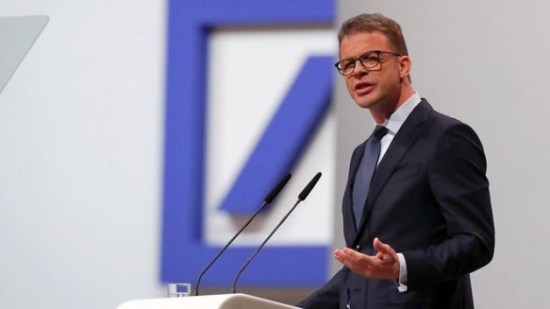
Up to 20,000 jobs could be axed at Deutsche Bank in a radical reorganisation of Germany’s biggest bank.

The investment bank is expected to be particularly hard hit, with many of the cuts set to affect London and New York.

“I can assure you: we’re prepared to make tough cutbacks.”

And You Thought Paying Back Your Student Loan Was A Bitch

And I’m sure it was but…

Debt

Germany’s World War I Debt Was So Crushing It Took 92 Years to Pay Off – After the Treaty of Versailles called for punishing reparations, economic collapse and another world war thwarted Germany’s ability to pay…

The Allies exacted reparations for World War II, too. They weren’t paid in actual money, but through industrial dismantling, the removal of intellectual property and forced labor for millions of German POWs. After the surrender, Germany was divided into four occupation zones, and in 1949 the country was split in two. Economic recovery, much less reparations payments, seemed unlikely.

By then, West Germany owed 30 billion Deutschmarks to 70 different countries, according to Deutsche Welle’s Andreas Becker, and was in desperate need of cash. But an unexpected ray of hope broke through when West Germany’s president, Konrad Adenauer, struck a deal with a variety of western nations in 1953. The London Debt Conference canceled half of Germany’s debt and extended payment deadlines. And because West Germany was required to pay only when it had a trade surplus, the agreement gave breathing room for economic expansion.

Soon, West Germany, bolstered by Marshall Plan aid and relieved of most of its reparations burden, was Europe’s fastest-growing economy. This “economic miracle” helped stabilize the economy, and the new plan used the potential of reparations payments to encourage countries to trade with West Germany.

Still, it took decades for Germany to pay off the rest of its reparations debt. At the London Conference, West Germany argued it shouldn’t be responsible for all of the debt the old Germany had incurred during World War I, and the parties agreed that part of its back interest wouldn’t become due until Germany reunified. Once that happened, Germany slowly chipped away at the last bit of debt. It made its last debt payment on October 3, 2010—the 20th anniversary of German reunification.

Who Makes This Stuff Up?

Oh, Al Jazeera makes this stuff up. Then it makes sense.

Germany

Germany welcomed refugees. Now it’s reaping the economic benefits – German companies need more skilled workers. Refugees are helping to fill the gap.

This is not the German reality. When Angela Merkel opened the floodgates in 2015, talk was soon everywhere (where talk like this was expected to be – see state television) that precisely this would happen; highly skilled engineers, doctors and other specialists from Syria would “fill the gap” in a booming German economy short on workers. This simply did not happen. The small number of specialists who did make it here were generally stymied by German bureaucracy or simply do not have the skills German companies expected them to have. Who did come? Armies of unskilled workers who are now a big burden on the German social system.

It’s not the Syrians’ fault that Germany does everything bass ackwards here, though. The Germans needed skilled workers so they let the unskilled in. They don’t even bother to introduce a comprehensive immigration law so they can decide who enters their country or not – haven’t gotten around to it to this very day. And on and on it goes. Al Jazeera’s fantasy Germany makes for good stories, I guess, but it has nothing to do with the real Germany. Not that anybody is interested. Just sayin’.

German Of The Day: Eigentum

That means property. But property doesn’t mean much in Germany anymore. At least not in Berlin under its current “red-red-green” city government.

Property

Another word you might be interested in here is Enteignung.

German officials facing protests and endless complaints about threats to affordable housing in the nation’s capital have decided the solution may be a five-year ban on rent increases and fines as high as $550,000 for violators.

Officials in Berlin, a city of about 3.7 million residents long known for its affordable housing options, announced this week that they plan to temporarily freeze the rents charged on publicly and privately owned apartments in a bid to halt runaway gentrification.

“It will scare away investors who will find alternative markets with less regulation. It’s a socialist and populist attack on the free market and it’s not going to lead to a single new apartment being built.”