Our CO2 Doesn’t Stink

Or maybe it’s green or something. At any rate, Germany just managed to block the adoption of new emissions limits for cars produced in the European Union. This was necessary because, well, this legislation would have handicaped Germany’s automobile industry, focused as it is on the luxury car sector.

Cars

Germany has long seen itself as a leader when it comes to efforts to reduce CO2 emissions and combat climate change. Indeed, Chancellor Angela Merkel’s government remains committed to radically expanding its reliance on renewable energies in the coming decades.

But when it comes to reducing the amount of greenhouse gases German-made automobiles produce, Berlin is far less ambitious.

“It is a scandal.”

Discountrepublik Deutschland

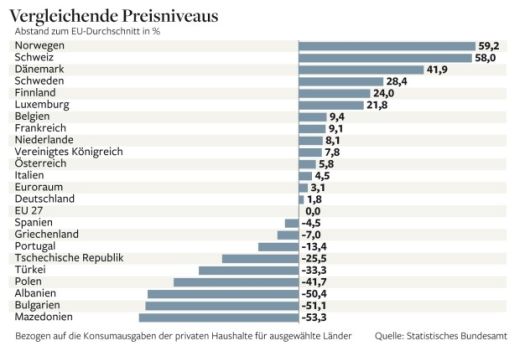
Verblüffender Befund (an amazing finding)? I don’t see how it could amaze anyone here – anyone who has ever gone shopping in Germany and then compared those prices to those you would pay in other European countries, that is.

Prices

Germans apparently aren’t aware of the fact that they have some of the lowest Lebenshaltungskosten (living costs or cost of living) in all of Europe. Of their immediate neighbors, it’s only cheaper to live in Poland and Czechia.

What is really amazing I find, however, is the fact that the Germans are able to enjoy these cheap prices while still having a higher per capita GDP than a lot of the European countries with a higher cost of living (Belgium, Denmark, France).

Beats the hell out of me. Hey, es darf eben nichts kosten here.

Verbraucher in Deutschland bekommen für ihren Euro mehr als die Menschen in den Nachbarländern. Lediglich bei den Nachbarn in Polen und Tschechien sind die Lebenshaltungskosten niedriger.

Black Workers Are Everywhere These Days

No, not Afro-American workers. You know, Schwarzarbeiter (illegal workers).

Black

And they’re everywhere all over Europe these days, although Germany is the champion here again too, as usual.

Eight million Germans are working on the black market as we speak, so-to-speak, generating about 13 percent of the country’s economic output. And loving it, I hope for them, because many of them just don’t seem to have any choice in the matter. Nobody will hire them otherwise:

Punitive tax regimes, increased labor market regulation and a growing lack of trust in governments are causing many Europeans to abandon formal employment and enter into the murky, illicit world of shadow economies worth billions of dollars.

Unternehmen und Arbeitnehmer setzen auf Schwarzarbeit, dadurch entstehen zwei Drittel des Schadens. Für das weitere Drittel ist verantwortlich, dass viele zu geringe Einkommen und Erträge ausweisen.

The Spiegel Says: US-Amerika One Big Debtor’s Prison

More and more Americans are being punished for their poverty: Above all in rural areas judges have been putting delinquent debtors in prison as of late. This medieval practice is illegal, unconstitutional – and widespread.

“Diese Unsitte verbindet man mehr mit der Zeit von Charles Dickens als mit dem modernen Amerika.”

PS: Speaking of deplorable customs and disturbing developments – and good fiction – when are these deplorable refutations of sacrosanct scientific certainties ever going to stop?! I mean, what ever happened to the ozone hole? It’s not there anymore or something.

Ozone

Well it’s One drink of wine, two drinks of gin… and I’m lost in the ozone again.

Ray Must Pay

Welfare fraud? In Germany? No way.

Ray

Way, Ray. Not even forest boys get a free lunch around here in poor but sexy but poor Berlin these days.

The city is sticking Ray with a 30,000 euro bill for all they did for him while he was doing all he could to them for about nine months back in 2011/2012. And they won’t remove that blindfold thingy there until he pays, either.

“Wir haben ihm Essen, Trinken und Kleidung gegeben und sogar einen Sprachkurs finanziert.”

“German System” Suffering From Irregularity

But only in other countries where “German system” weapons are being exported to, of course.

Guns

“How do these weapons end up in places they should not be?” a distressed Deutsche Welle asks with concerned Kulleraugen (big wide saucer eyes). They clearly don’t have proper gun control laws down there in those awful places. Not like we do here in Germany.

For example, in Mexico, police forces in states which are embroiled in a drug war are considered even by the central government as part of the security problem in their regions – nevertheless they have been issued with German-built G36 assault rifles, which can fire up to 750 rounds a minute. Germany’s Economics Ministry, which is responsible for export clearance, in fact sanctioned shipment of the weapons to Mexico – but not to the restive regions. The State Prosecutor in Stuttgart has launched an investigation into the German manufacturer of the G36 assault rifle, Heckler & Koch. The arms company told Deutsche Welle that individual employees, who have since left Heckler & Koch, were to blame for the irregularities.

Germany prides itself on having “strict, even restrictive regulations” for the export of weapons of war.

Alternative Reality Expensive As Hell

As part of Germany’s switch to renewables, industry has been exempt from paying higher prices associated with solar and wind energy. The European Commission, however, believes the practice distorts competition on the Continent. Huge penalties could be in store.

Bill

The costs of start-up financing for green energy and the compensation for expansion of the power grid are added to customers’ electricity bills in the form of a special tax. The entire subsidy system is supposed to come to an end when green energy becomes competitive. That, at least, is the theory.

But the reality is different. No longer can one simply describe the tax as a way to get renewable energies off the ground. Indeed, following Berlin’s decision two years ago to shelve nuclear energy and accelerate the expansion of renewables, the EEG (Renewable Energies Act) has become a giant redistribution machine.

“The fact that German electricity prices are among the highest in Europe despite relatively low wholesale prices must serve as a warning signal.”

Kleinvieh Macht Auch Mist

Literally, “small animals make manure, too.” But of course this German idiom means more. What they’re really saying is “every little bit counts.”

Kleinwaffen

And the Süddeutsche Zeitung just found a whole bunch of manure when it brought out a report about German small arms sales. They hit an all-time high in 2012, at more than double the previous year’s sales.

And Germans are really concerned about this (not). Not at all, really. As a matter of fact, as far as I can tell, the only time Germans seem to get concerned about small arms is when one of those crazy Americans goes berserk and uses one to kill a bunch of innocent people again because there is simply not enough effective gun control legislation in that dang dern US-Amerika country of theirs. Legislation aimed at stopping small arms imports from Germany, I suppose they mean.

Exporting small weapons is a contentious issue as they are used to kill far more people than heavy weapons and major military equipment around the world. Amnesty International estimates that 1,000 people die each day from gunshot wounds inflicted by small arms. Owing to their size, they are also the hardest weapons to keep track of, and circulate with comparative ease in conflict zones.

Drink Your Fracking Beer Already

Uh oh. Germans are suddenly worried about their Reinheitsgebot or “German Beer Purity Law” again. And Fracking, I mean.

Fracking

This has to do with the fact that fracking does not stick soley to the only ingredients that may be used in the production of beer: Water, barley and hops. As a matter of fact, I don’t even think that fracking uses barley and hops at all.

I’m interested in tradition, too, of course. But let’s face it, if you’re going to start quoting a 500-year-old “purity law,” quote it right: The law also set the price of beer at 1-2 Pfennig per Maß.

The Brauer-Bund beer association is worried that fracking for shale gas, which involves pumping water and chemicals at high pressure into the ground, could pollute water used for brewing and break a 500-year-old industry rule on water purity.

“Das Reinheitsgebot darf nicht beeinträchtigt werden. Es müssen alle Maßnahmen ergriffen werden, damit das Brauwasser geschützt wird.”

150 Years Old And They Still Haven’t Figured It Out

Socialism, of course, has never worked. Not once. Not in any form.

SPD

And German social democracy (like social democracy and their even cheaper imitations everywhere else around the world), although doing its best not to ever actually use the word socialism itself, is of course nothing other than the democratic attempt to reach that very goal. Which has never worked (once “reached”), like I said. But still.

So today the German SPD gets to celebrate its bittersweet 150th birthday — trailing badly in polls ahead of September elections and hearing praise for its efforts to reform Europe’s biggest economy from French President Francois Hollande, a recent left-wing winner who has also lost his luster.

Hey, whatever. More power to them and Happy Birthday and all that because, well, I kind of admire them in a way. But only kind of. They’re like a bunch of nutty professors who simply refuse to believe that their never-ending pursuit of the perpetual motion machine is maybe sort of not such a great idea – and a big waste of time after all. You know, searching for a machine that produces “motion that continues indefinitely without any external source of energy; impossible in practice because of friction?”

There’s always friction out there, you see. It’s called reality. Or self-interest, if you prefer. Or the desire of individuals to live their lives without interference from others who aren’t interested or able to live their own?

Or maybe just money, in the end. Like Margaret Thatcher once said: “The problem with socialism is that you eventually run out of other people’s money.” Strange, isn’t it? But that’s the SPD’s problem, too. Happy Birthday anyway! Now just shut up and cut the cake already.

“No other party has been able to last so long, because its core demands have constantly remained relevant in new ways: freedom, social justice and political participation.”