German Trust In Media Rises Sharply After Being Told That German Trust in Media Rises Sharply

German told their trust in newspapers soars to record level.

Trust

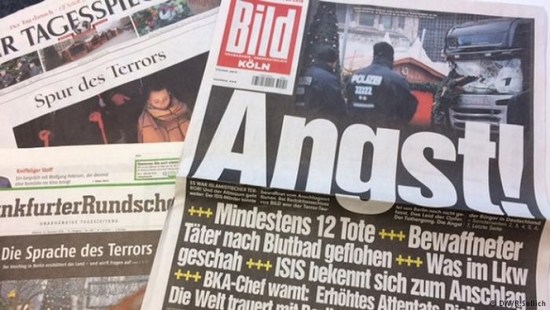
After being told that a total of 55.7 percent of respondents to a study said they trust the print press, a total of 55.7 percent of respondents to the study said they trust the print press, a drastic rise on the 45.7 percent of respondents who gave that response in 2015, they were told, and the highest level of trust since the survey was first conducted in 2000, somebody told them, too. Or so I’ve been told.

Noch nie seit über 15 Jahren war das Vertrauen in die Presse so hoch wie heute. Den deutschen Medien ist es gelungen, das in sie gesetzte Vertrauen zu stärken und weiter auszubauen.
Suspect X From County Y

Or German of the day: Migrationshintergrund.

Angst

That means migration background.

It might be the norm in other countries, but in Germany, revealing a criminal’s country of origin in the media is still highly controversial. But some say that doing so can even serve to rectify prejudiced opinions.

Rectify prejudiced opinions? You mean, knowing the truth might “rectify” the opinions you don’t want people to have? Sure, that might be a good start. Might not be. Hard to say for sure.

The suspect is a “German WITHOUT a migration background.”

German Of The Day: Inside Islam

That means Inside Islam and it’s the name of a new book by journalist Constantin Schreiber.

Inside

In it he describes his visits to 20 randomly selected “normal” mosques in Germany (he avoided anything that had to do with extremism) and how he was alarmed to discover that the preachers there were not only conservative but also undermined all German efforts directed toward equality and integration.

Believers were exhorted to live by Islamic values and to stay away from the sinful ways of the world outside. Those who do not follow Islamic rules were threatened with the hell fires of the other side.

One preacher’s statement sums it up nicely: “You can’t be both a Muslim and democrat (a supporter of democracy). There can be nothing that is both sweet and bitter.”

“Ich habe, wenn ich mit den Imamen sprechen konnte, auch immer die Frage gestellt, Denken Sie, dass Ihre Moschee ein Ort für Integration ist? Und es haben alle Imame interessanterweise gesagt, ja, unsere Moscheen sind Orte für Integration. Wenn ich dann aber zum Beispiel gefragt habe, wie lange sind Sie denn in Deutschland, dann habe ich zu hören bekommen, neun, elf oder vierzehn Jahre, dann habe ich gefragt, sprechen Sie Deutsch? Nein.”

Germans Involved In Airstrike?

What, like an airstrike for higher pay and more vacation? Or one for planes that actually fly? This must be some kind of a misunderstanding or something. German war planes (the ones that still fly) are only used on missions of goodness and niceness.

Airstrike

German jets reportedly passed intelligence to the anti-IS coalition for an airstrike that killed dozens of civilians in Syria. Germany only provides reconnaissance and does not carry out attacks.

“The conflict in Syria is very heavily dependent on aerial intelligence. Countries which may not be involved in the direct fighting in Syria, such as Germany, are nevertheless playing a key role in gathering crucial aerial intelligence, which then feeds into lethal strikes by others, primarily the United States.”

Maybe London’s Just Not All That Much Into You, Frankfurt

Now that national interest rates are up, I mean.

London

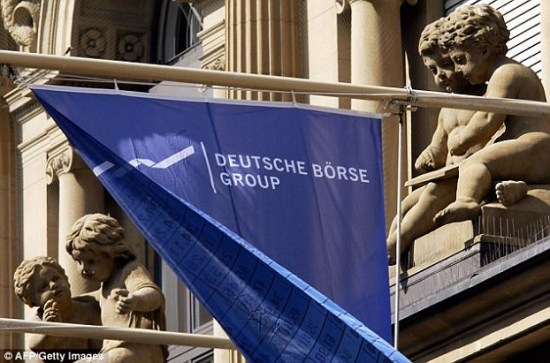
A German bid to buy the London Stock Exchange has been sunk by the EU competition watchdog.

The Frankfurt-based German exchange Deutsche Boerse was bidding to buy the LSE in a deal that critics have warned would be against Britain’s national interest.

The Art of the Deal: Die Europäische Union, aber auch die britische Regierung betreten damit ein völlig unbekanntes Gebiet. Desintegration war bislang nicht vorgesehen.

Scientific Team That Discovered Gravitational Waves Hired By SPD To Discover “Schulz Effect”

The scientists and engineers who made the first-ever direct detection of gravitational waves are now being asked by Germany’s SPD to provide conclusive evidence that the so-called “Schulz Effect” exists, too.

Schulz

After miserably failing their first electoral test this past weekend under their new leader, Martin Schulz, some voices in the SPD ITSELF are now questioning whether or not the infamous effect ever even existed in the first place. Much less now.

“Like, where’s the Rindfleisch (beef)?” asked one disgruntled social democrat after his party rolled over and died last Sunday in Saarland. “I was led to believe that this effect was unstoppable and here we are crapping out again, as usual, at the very first opportunity we get. Enough of these affected claims about the effect, comrades. I want some hard scientific evidence. And I want it pronto.”

The rest of Germany could not be reached for comment as it never believed in the “Schulz Effect” in the first place. The scientific team, also unaffected by the effect, will begin it’s groundbreaking work effective immediately.

“SPD-Messias” Schulz in der Falle: Seine einzige Machtoption könnte bei Merkel liegen.

German Of The Day: Pest oder Cholera

That means the plague or cholera. You know, as in having to choose between the two?

Saarland

That’s what voters in Saarland get to do today: Ch00se between Merkel’s too big to fail plague or “Schulz effect” cholera. May the best pestilence win.

Germany’s election year gets under way in earnest on Sunday when voters in Saarland choose a new state assembly, the first test of the Social Democrats’ surge in polls since they chose Martin Schulz to run against Merkel in September. The chancellor’s Christian Democrat-led bloc and the SPD were even at 32 percent each in an Infratest Dimap national poll published Friday.

Twisted German Scientists Devise Fake Sun

In a desperate attempt to save Germany’s failing renewable energy revolution, a group of depraved German scientists has devised a fake sun to keep German solar power plants running at night (one of the depraved scientists can be seen below).

Sun

The “Synlight” artificial sun, soon to be placed in low geocentric orbit above the country, uses lots and lots and lots of xenon short-arc lamps that generate 4,000 times the wattage of the average light bulb and will be switched on during varying intervals between 19:00 in the evening and 04:00 in the early morning hours, hopefully allowing German solar energy plants to finally produce enough energy to operate small radios and kitchen appliances simultaneously (but too many at once). Provided it isn’t too cloudy outside, of course. Which it practically always is here. But still.

“In four hours the system uses about as much electricity as a four-person household in a year.”

Steinmeier First President Ever To Put Parliamentarians Asleep During First Half Of Swearing-In Ceremony

In a refreshing twist on the rather staid traditions of German presidential swearing-in ceremonies of the past, Germany’s new president, Frank-Walter Steinmeier (SPD), broke with protocol and chose a speech that put a large number of German parliamentarians asleep a mere seven minutes into the ceremony.

Steinmeier

“Wah?” said one startled representative from Rhineland-Palatinate as a Bundestag usher gently nudged him awake. “Good point. I couldn’t agree more!”

Steinmeier is regarded by many in Berlin as possessing the qualities necessary for the office of president: He is boring, ineffective, mediocre in every way and… Boring.

“Germany needs strong leadership, especially in the current situation.”

German Happiness Hits Record High And Sure The Hell Better Stop Soon

Because, you know, the happy Germans are really starting to piss off the regular, less-than-happy-silent-majority ones (see happy Germans below).

Happy

A new study shows that Germans are more satisfied with their lives now than at any point since reunification in 1990. The research by the German Institute for Economic Research Friday showed that life satisfaction among Germans had hit 7.5 out of ten on their happiness scale. The DIW has interviewed 30,000 people each year since 1984 on a variety of themes including work situation, health, education and income to understand how Germans are doing in their lives.

“It is sobering to see that satisfaction among east Germans still trails that of west Germans after all these years, but at the same time, the gap is smaller now than it has ever been.”