What’s 20 (30? 40?) Billion Euros These Days?

It’s peanuts, man. Renewable peanuts.

Damn. This gives power madness a whole new meaning.

Germany mapped out a 20 billion euro ($25 billion) plan on Tuesday to expand its power grid and avoid a “power gap” as Europe’s largest economy switches away from nuclear to renewable energy.

Germany’s government, the federal energy network regulator and transmission grid firms unveiled joint plans for thousands of kilometres of new electricity lines to 2022, to help distribute volatile renewable energy.

Operators say some 3,800 kilometers of new power lines needed through 2022.

Heretics Verboten!

Europe Doesn’t Need the Euro? Another religious tract to study on Sundays.

All of this is kind of like religion, don’t you think? First you’ve got some prophets who come out of the wilderness (the political class preaching the virtues of the euro, come hell or high water), then what they say gets labeled as heresy by the faithful (by the “man on the street” who wants to keep his deutschmark), then the euro faith overcomes this persecution, establishes itself as the true universal teaching and becomes orthodoxy. Then the next voice out of the wilderness comes along and the game starts all over again, etcetera and so forth already.

Don’t get me wrong, I don’t beleive that Thilo Sarrazin is a full-fledged prophet or anything (I just think he wants to make a buck, I mean euro). But he’s not a full-fledged heretic, either. And that’s something the euro high priests could never admit to.

The euro, in Sarrazin’s view, is just the old German deutschmark extended to a lot of countries with less robust currencies.

Germany, in other words, is being used as a guarantor of other countries’ debts.

“The German political class bet that the political union would follow shortly thereafter almost as a matter of natural law, because without that the common currency wouldn’t be stable. That bet has failed.”

Germans are hostage to their sense of not wanting to be responsible for Europe’s failure.

Germans are hostage to their sense of historical guilt.

“Pro-euro Germans are driven by that very German reflex, that we can only finally atone for the Holocaust and World War II when we have put all our interests and money into European hands.”

“Angela Merkel to like the friendly woman on the navigation system in my car.”

If It Wasn’t For Schadenfreude I Wouldn’t Have No Freude At All

This just in: The German joy gene is broken. Holy freakin’ Makrele (mackerel)! Who would have ever thought that?

But here we have it. The latest German joy gene task force survey says: 46 percent of Germans reveal that they are increasingly unable to enjoy anything, 55 percent of younger Germans even claim to feel they have lost their ability to feel good at all and 81 percent of those surveyed said that the only time they experience pleasure is when they have managed to “achieve something” first. You know, like when “a motorcyclist reported experiencing delight when he blew exhaust fumes in the direction of a convertible driver as he accelerated at a green light.”

Wow. I would have never thought that Germans were self-denying overachievers completely incapable of enjoying themselves (unless it’s schadenfreude) and weighed down by their penchant for perfectionism and their inability to relax, you?

Meanwhile, chances to create a sense of well-being lurk everywhere — a glass of wine, a relaxing bubble bath, or a nice restaurant with delicious food. These, of all things, also rankle the Germans. “This glut of offerings pressures people into thinking, ‘I must enjoy everything’.”

It’s Good To Be The German

In case you didn’t know it, Germans are sitting on a big honking tremendous pile of money.

The Bundesbank thinks that German private households are in posession of ein paar tausend Milliarden or “a few thousand billion” euros (stick with that, believe me: Billion is Milliarde in German, trillion is Billion). They’ve got more set aside now then ever before, in other words; some 4.7 trillion euros.

And the punch line is that they seem to have invested most of it at those awful horrible dreadful banks they like to despise so much (they make big banks even bigger, you might say). Investments in real estate haven’t even been calculated here, by the way. Rereading this is starting to make my stomach hurt.

Privatleute vertrauen Vermögen den Banken an.

Energy Revolution Not Taking Place Quite Yet

German energy turnaround revolutionaries everywhere are turning around more than usual these days, burning more energy than planned trying to answer all the dumb questions those dumb energy reactionaries are always asking them.

Dumb questions like:
How come the energy turnaround isn’t making any progress?
How come the taxpayers continue to foot the bill?
How come all these renewable energy companies are going broke now that the subsidies are being cut?
How come made in Germany renewable energy technology is now being made in China these days (and German subsidies are actually helping the Chinese)?
How come Germany isn’t in the position to create the power-transmission lines needed to connect these new energy sources to the German power grid?
How come the energy-storage facilities needed for these new technologies are so extremely expensive and, well, just aren’t being built?
How was that again? How come Germany is in the process of turning off all its nuclear power plants?
How come the construction of dozens of new coal-burning power plants will therefore be necessary?

And how could ideology get the upper hand on reality (yet again) in a nation full of such sober, experienced thinkers?

And on and on and on these dumb questioners go. These reactionary types just don’t get it, you see. They don’t have visions like us revolutionary folks do. And they don’t hear the voices, either.

Germany Stalled on the Expressway to a Green Future

It Still Can’t Happen Here

Can it?

Germany could be a target of an Islamist attack similar to those carried out by a gunman in France two months ago, the head of the country’s intelligence service said on Tuesday.

German intelligence chief Heinz Fromm’s comments, quoted in an interview with the top-selling Bild daily, follow a series of clashes in several German cities and towns between police and ultra-conservative Salafist Muslims.

“The danger for Germany has unfortunately not decreased. And it is not by any means abstract. An attack like in France in March… is also conceivable here.”

Hertha Down, Bayern Out

The German Football Federation has rejected Hertha Berlin‘s request to have their relegation play-off fixture with Fortuna Dusseldorf replayed due to fan unrest.

Home groan: How Bayern’s night of destiny became a nightmare.

FC Bayern have lost their last five matches to Borussia Dortmund, the DFB Pokal and the last two championships to Die Borussen and will need to recover quickly ahead of next season.

The Great European Divide

There’s Germany, it seems. And then there’s (practically) everybody else in Europe.

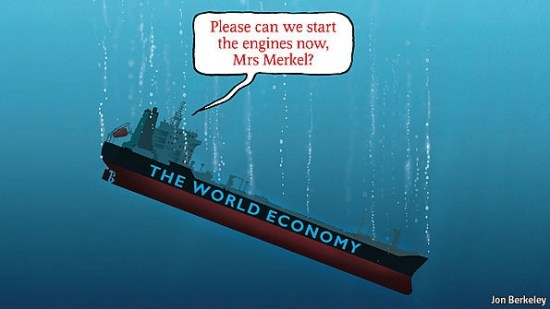
The Economist notes: The hope is that Germany, which produces over a quarter of euro-zone output, can pull along the rest. But the worry is that the latest bout of euro sickness may sap confidence even in Germany, aborting a broader recovery.

With unemployment at 6% compared with a 15-year high of 11% across the euro zone and over 20% in Spain and Greece, Germans feel less pressure to save in case they lose their jobs. And a more confident Germany helps everyone by spending more on imports. German inflation at 2.2% is now below average.

German resilience reflects several strengths. Although growth in the first quarter was helped by exports, the usual mainstay, it has increasingly been backed by domestic demand, which accounted for three-quarters of GDP growth in 2011. This reorientation has happened because Germany avoided the debt excesses (? hmmm, relatively speaking perhaps, but I’ve seen some other numbers here), both private and public, that inhibit growth elsewhere. With relatively low debt, German households and firms can borrow more. What is more, they can do it at rock-bottom rates. Paradoxically, Germany is benefiting from the euro crisis, as investors seek a haven. Yields on ten-year German government bonds have fallen below 1.5%.

Paradoxically, Germany is benefiting from the euro crisis, as investors seek a haven. Yields on ten-year German government bonds have fallen below 1.5%.

And yet, after having read all these impressive figures up there, there’s another German paradox I keep running into here all the time: Germans on the street aren’t nearly as confident as this article wants to imply, at least not when it comes to the euro and the euro-zone. How else do you explain the fact that nearly every second German now thinks that the introduction of the euro was a big honking mistake in the first place?

Die Euro-Einführung war ein Fehler, glauben knapp die Hälfte der Deutschen.

Happy Christi Himmelfahrtskommandotag!

Vatertag is also Ascension here (or the other way around), and a real holiday. And a real boon to the German liquor industry, too.

And there really is some connection between the two holidays here somewhere, I think. Jesus is known to have drunk wine and wander around the countryside with his buddies, for instance. Although without the Bollerwagen (handcarts), of course. Nor did they ever drink and drive, as far as I know.

Not so here in Germany, however. Bild tells us that there will be three times as many alcohol-related accidents today as usual. And I believe it, too. Just ask these guys down here.

Herrentag ist Unfalltag!

PS: Christi Himmelfahrt is the Ascension. A Himmelfahrtskommando is a kamikaze operation.