German Of The Day: Freeloader

That means freeloader. Actually, the German word for that is Schmarotzer but this is so-called Neudeutsch or New German (English) so relax about it already.

Freeloader

Anyway… Germany must increase its military spending and take a more active role in conflicts to avoid being seen as one of the world’s biggest freeloaders, an influential diplomat said on Wednesday.

Wolfgang Ischinger, chairman of the Munich Security Conference and Germany’s former envoy to Washington, urged the country’s would-be government coalition partners to reverse their restrictive stance on arms exports and formally back commitments to NATO.

Damn. And this is a diplomat talking here so you can imagine the words less diplomatic folks like you and me would use.

“We should not develop the reputation of being one of the world’s best freeloaders.”

More Redistribution Needed

Or that’s what this article seems to suggest.

Redistribution

And this in a country that has already been redistributing the wealth for decades and decades or longer.

When it comes to the superrich, however, there are relatively reliable estimates in the form of lists of the world’s wealthiest people, with the one compiled by the US business magazine Forbes leading the way. A similar list is compiled in Germany by manager magazin. A team of tax experts led by Stefan Bach of the German Institute for Economic Research (DIW) has examined the wealth statistics compiled by the ECB and augmented them with lists identifying the ultrarich. And the team did so for three countries: Germany, France and Spain.

The result: The 45 richest households in Germany own as much wealth as the bottom half of the population. Each group possessed a total of 214 billion euros in assets in 2014.

Bad superrich! Bad!

Why would more redistribution be necessary in a country like Germany? Maybe because it doesn’t work. It can’t work, in fact. It is not, nor has it ever been, a zero sum game, this wealth business. Here or anywhere else. But it’s a great way for redistributing politicians to get elected. Again and again and again. To no avail.

“Most economic fallacies derive from the neglect of this simple insight, from the tendency to assume that there is a fixed pie, that one party can gain only at the expense of another.”

No Alternative Facts Or Fake News Here

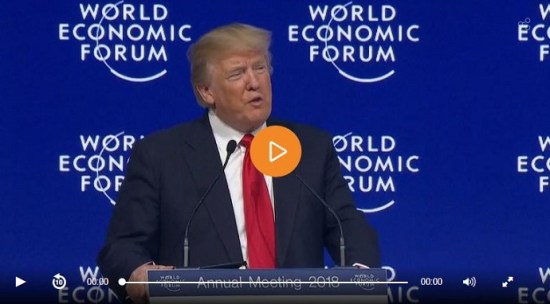
While President Donald Trump held his speech at the World Economic Forum in Davos on Friday he brought up one of his favorite themes: “Fake news” and malicious journalists who are ought to get him.

Trump

There were some boos in the crowd following this. No big surprise here. But responsible journalists at Germany’s Staatsfunk channel ARD, concerned that these boos might not be as audible on their recording as they “ought” to be, tweaked the audio to make the boos louder.

The outrage in Germany hielt sich in Grenzen (was limited) when this came out, of course, but a few German journalists were nevertheless less than impressed with the ARD’s methods. “You’ve clearly overstepped the limits for a news broadcast,” wrote one journalist. “And it’s hard to imagine that you would have done the same should there have been applause.”

„Die @tagesschau hilft ein bisschen nach, damit Buh-Rufe gegen Trump lauter und deutlicher zu hören sind. Klare Grenzüberschreitung bei einer Nachrichtensendung, lieber @KaiGniffke. Und schwer vorstellbar, dass Sie dasselbe bei Applaus getan hätten“, schreibt Reichelt.

Germans Can’t Live Without Facebook

Or at least that’s the impression I get. Otherwise, if they were so terribly worried about what Facebook does with their data, they would simply stop using it. It’s still a “free” service, right? But, of course, nothing is ever for free.

Facebook

Facebook is open about collecting a broad variety of personal information, from facial recognition data to, yes, “likes” on other sites. Privacy-minded people can easily find out what Facebook knows about them and even download the data. So it’s not as if users were deceptively kept in the dark about Facebook’s harvesting of “21st century raw materials.” That, however, is not the Federal Cartel Office’s main concern; it’s that Facebook, as a company dominant in its market, forces users to agree to these harvesting practices: They don’t really have any place else to go for their digital social needs if they feel uncomfortable about how their data are used. If it’s a choice “between accepting ‘the whole Facebook package,’ including an extensive disclosure of personal data, or not using Facebook at all,” as the regulator put it in a December document, and if Facebook is a dominant company, it’s illegal in Germany.

The regulatory attack on personal data harvesting is based on the unproven assumption that the data are valuable.

“Not Deployable For Collective Defense”

Three years ago, Germany’s military made headlines when it used broomsticks instead of machine guns during a NATO exercise because of a shortage of equipment. The lack of real weapons in the European Union’s most populous nation was seen as symptomatic of how underfunded its military has long been.

Germany

One Russian annexation later, if anything, the state of affairs has only gotten worse, according to the parliamentary commissioner for the country’s armed forces.

He has now reached the conclusion that the German military is virtually “not deployable for collective defense,” at the moment. Independent commissioner Hans-Peter Bartels also indicated in a recent interview that Germany was unprepared for the possibility of a larger conflict even though smaller operations abroad may still be possible.

Meanwhile… Rising exports, Turkish tanks fuel German arms sales debate.

Again: Germany’s army is an alibi army that will never be used for anything other than to make Germans feel better (less worse?) about being 1) pacifists while being at the same time 2) the world’s third largest weapons exporter. Remember this when the next demand for them to spend 2 percent GDP on their defense comes up and they start to fidget – and get away with not spending it again.

More Censorship Fun

This time Germany’s way cool new censorship law (NetzDG or Netzwerkdurchsetzungsgesetz, if you prefer) has seen to it that a German artist’s works be effectively banned on Facebook and Instagram because, well, no one even bothered to explain why this time.

Barbara

That road sign up there is a form of hate speech, you see. If you look closely, I mean. It’s sexist, right? Or is it racist (the dark part)? I don’t know but something is definitely distrubing about it and I think that the nameless employee who pressed on the Censor Sensor Button or whatever it is they call it was right on the money. Better safe than sorry, I say. When it doubt, censor it out. It’s good to know Big Bruder is watching.

“Über das Löschen von Beiträgen entscheiden irgendwelche Angestellte von privaten Firmen im Auftrag von Facebook und Instagram, die im Schnellverfahren entscheiden und nicht einmal irgendwelche Gründe für das Löschen nennen. Ich sehe die Freiheit im Internet dadurch mehr als nur bedroht, sie wird aus meiner Sicht dadurch ruiniert.”

Heart-Warming German Children’s TV

Financed by the German Staatsfunk mafia, too.

Kika

It’s so cute or something. German children’s channel KiKa broadcast this touching love story between these two sixteen-year-old kids. One is a German, one is a Syrian refugee. Heart-warming, like I said. Especially once you realize that the Syrian is actually 20 (at least) and that he is also a big fan of German Salafist hatemonger preacher Pierre Vogel.

Young German girls are crazy about this kind of romantic stuff, I guess. And you got to give the people what they want, right? And they can’t be subjected to it early enough, I suppose. So it’s also heart-warming to know just where all those GEZ “contribution” euros go. Not that anybody can do anything about that or anything. Just saying.

Der syrische Flüchtling soll laut Angaben der Bild-Zeitung die offizielle Fan-Seite des deutschen Hasspredigers und Salafisten-Führers Pierre Vogel geliket haben. Vogel war Mitglied eines inzwischen aufgelösten salafistischen Vereins, der vom Verfassungsschutz beobachtet wurde. Er gilt als einer der einflussreichsten Prediger der deutschen Salafismusszene.

What Goes Around…

Couldn’t have happened to a nicer Big Brother.

Maas

Germany’s justice minister has fallen victim to the rules he himself championed against online social media, as one of his tweets was deleted following several complaints, Bild daily reported Monday.

The tweet dated back to 2010, when Heiko Maas was not yet a minister.

In the post, he had called Thilo Sarrazin, a politician who wrote a controversial book on Muslim immigrants, “an idiot”.

In der Debatte um das Netzwerkdurchsetzungsgesetz (NetzDG) wird Heiko Maas von einem Tweet eingeholt, den er vor sieben Jahren verfasst hat. Durch das neue Gesetz, das der SPD-Politiker und Bundesjustizminister entworfen hat, sollen strafbare Äußerungen im Internet schneller gelöscht werden.

Food For Thought Police

“Please spare us the thought police!” read a headline in Wednesday’s Bildzeitung.

Feige

As recently reported, the latest German censorship craze (exemplified by the Netzwerkdurchsetzungsgesetz or “Internet Enforcement Law”) is already being abused by those who would make us think what we are told. This type of thing never takes very long, of course. I read this in a book in high school once long, long ago in a galaxy far away. It was called 1984 or something. The book, I mean.

Anyway, this law… meant to curtail hate speech on social media in Germany is stifling free speech and making martyrs out of anti-immigrant politicians whose posts are deleted. The law which took effect on Jan. 1 can impose fines of up to 50 million euros ($60 million) on sites that fail to remove hate speech promptly. Twitter has deleted anti-Muslim and anti-migrant posts by the far-right Alternative for Germany (AfD) and blocked a satirical account that parodied Islamophobia.

But the case I really like is this one here: A German thought criminal had the audacity to criticize Germany’s reticence to support the protests in Iran and write “one could get the impression that Germany has become an unbelievably cowardly nation” in Facebook. This horrid example of hate speech was enough to get the user promptly blocked.

The outrage about this outrage about the other outrage (I’m running out of outrages) among the German population also remains rather reticent, to say the least. But they are law-abiding citizens, after all. The Germans. They don’t want to commit any thought crime or anything.

Einer der beiden Fälle betrifft Irina Schlegel (33), die Chefredakteurin des Kreml-kritischen Recherchemagazins „InformNapalmDeutsch“. Sie schrieb am 1. Januar im Zusammenhang mit der deutschen Zurückhaltung zu den Protesten im Iran: „Man bekommt den Eindruck, Deutsche sind eine unglaublich feige Nation geworden“. Zwei Tage später löschte Facebook den Post und sperrte die Verfasserin für drei Tage.
Thank Goodness We Have Experts

Otherwise we dummies down here in the street would have never, ever in a million years been able to figure out that the spike in violent crime in Lower Saxony is directly related to the arrival of migrants there.

Crime

And thank goodness this is only the case in Lower Saxony, right?

The German state of Lower Saxony witnessed a 10.4 percent increase in crime at the height of the migration crisis, according to a study. The study’s authors said age and reporting practices factored into the connection…

According to the study, which was conducted by the Zurich University of Applied Sciences and paid for by Germany’s Ministry of Family Affairs, police witnessed an increase of 10.4 percent in reported violent crimes in 2015 and 2016. More than 90 percent of the increase (not of total violent crimes) was said to be attributable to migrants.

I know, I know. How distasteful. How can they be allowed to publish studies like that? Couldn’t somebody censor them or something?

Wissenschaftler haben die Gewaltkriminalität von Flüchtlingen am Beispiel Niedersachsens untersucht. Sie rechnen fast jede achte Gewalttat einem Asylsuchenden zu.