It’s Not Easy Being Optimist-In-Chief

When it comes to dealing with Europe, I mean. Optimism is suspekt (makes suspicious) here. There is always an angle to everything, you see.

Larry Page

For him (Larry Page), the real danger is opposing technological progress and greater efficiency. Such dangers lurk particularly in the Old World: “Especially in Europe, it appears easy to ignore the fundamental physics of a question in order to claim everything is just fine when things here cost twice as much as elsewhere. This attitude worries me greatly, because it hinders the work of entrepreneurs.”

But should not a society also have the right to say “No” to a superior technology? Certainly, agrees Mr. Page. But that’s not particularly clever. “If you make everything twice as expensive, you reduce people’s quality of life.” And do you really want to keep local entrepreneurs from making their contribution to the global economy? Naturally it’s great when citizens have the feeling they can decide. “I’m merely saying that when they make decisions contrary to a global system of capital, then they have to do that consciously and seriously. And I don’t believe anyone is doing that.”

“If I were a young entrepreneur today and I had the choice of starting my Internet firm in Germany or Silicon Valley, it wouldn’t be a hard choice. And regulation will only get worse in Europe. It will be very hard to build a company of global import there.”

Gerade die Europäer neigen in den Augen von Larry Page offenbar zu falscher Nostalgie. “In Europa scheint es leicht, die grundlegende Physik einer Frage zu ignorieren und zu behaupten, es ist schon in Ordnung, wenn Dinge hier doppelt so viel kosten wie anderswo”.

German Of The Day: Zwangsbeitrag

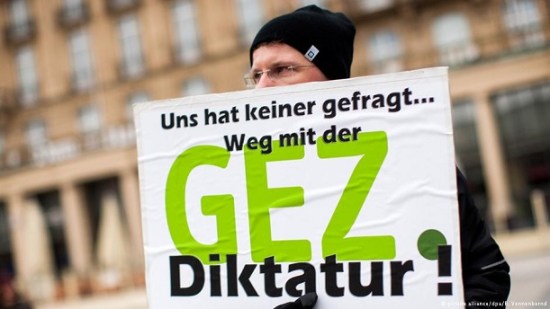
That means “compulsory contribution” and refers here to the TV fees every German household has to pay for Öffentlich-Rechtliche or public-sector (or state) TV. You have to pay this here, you see, whether you watch these channels or not. You have to pay this here whether you even own a TV or not. Germany has the most expensive public-sector TV channels in the world, by the way.

ARD

Sounds reasonable, right? Hardy, har har. Well, now German “scientists” have suddenly figured out that Germany no longer needs these expensive public-sector channels and that they can be, pardon my French, “privatized.” German scientists are notoriously thorough, you know, and that’s why it takes them a little longer than other folks to figure this kind of stuff out.

Other Germans will not want to hear this, however. This is because, well… It’s hard to say why this is. It would mean getting rid of Tatort, for one thing. This would be earth-shattering or something. And in the end, Germans also want to have an official opinion maker, I suppose, someone they can always go to when they need an official opinion of their own, so-to-speak – and Der Spiegel isn’t handy at that moment.

The more things change the more they stay the same. So don’t even THINK about changing channels. “That’s right, folks. Don’t touch that dial!

Wissenschaftler stellen bei der Betrachtung von ARD und ZDF fest: Deutschland braucht nicht länger den teuersten öffentlich-rechtlichen Rundfunk der Welt.

Forget Mediation

What these guys need is some meditation. Or maybe some heavy medication.

Strikes

Don’t worry. These GDL train drivers will be back for strike number ten before too long. And not that anybody cares anymore or anything, but the post office employees and kindergarden cop-people are still on strike here, too.

Remember when Germany used to be a “first world” country?

The latest strike is the ninth walkout in just 11 months and follows a five-day train strike earlier in May, which was the longest in Deutsche Bahn’s 21-year history.

German Of The Day: Nervensäge

That means “nerve saw” or annoying person. And heaven knows that Claudia Roth of the German Greens has spent an entire career making a name for herself in that department.

Roth

The Frankfurter Allgemeine Zeitung even once referred to her as the “Mother of All Nerve Saws.” But that was then and this is now. She has clearly mellowed out now that she just turned 60 (today). Now it’s more like she just gnaws on your nerves.

Happy Birthday, Claudia!

Selbst Etiketten wie “Mutter aller Nervensägen”, wie die “FAZ” einmal schrieb, ärgern die streitbare Politikerin nicht. Im Gegenteil: Im Bundestagswahlkampf 2013 griff sie das Thema selbstironisch auf, eine Parteikampagne für mehr weibliche Mitglieder warb mit dem Spruch: “Wer nervt mehr als Claudia?”

This Gives “Please Keep Off The Grass” A Whole New Meaning

More budding crime in Kreuzberg. I bet the Greens planted this stuff. Or maybe some other dope. What a bunch of crackpots.

Pot

Kreuzberg is a really seedy district, you know. And these weren’t even potted plants. They just found this stuff among the weeds.  I tell you, this town is really going to pot…

I got a million of ’em, folks!

Dass in Berlin-Kreuzberg öffentlich ein Joint geraucht wird, ist nichts Besonderes. Aber bei mehreren hundert Cannabis-Pflanzen auf einer öffentlichen Grünanlage wird dann selbst in Berlin die Polizei aktiv.

Even When We Win We Lose

Or so it goes with SPD these days.

SPD

Germany’s Social Democrats, Chancellor Angela Merkel’s coalition partners, on Sunday suffered their worst-ever electoral setback in regional polls in Bremen, raising questions about party leader Sigmar Gabriel’s hopes of gaining ground nationally on Ms Merkel’s conservative Christian Democrats.

So sehen Sieger aus (this is what winners look like):

FDP

In Bremen ändern 6,5 Prozent für die FDP nicht viel. Im Bund aber eröffnet ihre Wiedererweckung Gedankenspiele für die Wahl 2017.

A Green Superpower?

Germany?

Coal

Germany is a superpower when it comes to setting ambitious goals. But it’s even better at burning coal.

Germany aims to generate 80% of its power from renewable sources by 2050 with nuclear being fully phased out by 2021. But given the costs associated with renewables and the challenge of replacing nuclear power efficiently, it is not clear that Germany will succeed in either of these goals…

The Germans have increasingly turned to coal as their power generation source of choice, especially U.S. coal. Today coal power plants are responsible for generating nearly half of Germany’s power, and numerous new plants are scheduled to come online in the next few years.

Overall, the increase in coal is likely to create a significant increase in airborne pollution and potentially stoke tension between Germany and its neighbors. But at the same time, if Germany wants to phase out nuclear power, coal is the only realistic option; a fact which some German politicians are starting to admit.

Do They Strike This Much In Greece?

European travelers have contended for weeks with the possibility that Greece’s dwindling finances might lead to empty ATMs. They should have concerned themselves instead with Germany.

ATM

While cash machines in Athens are still operating without any trouble, striking couriers in Berlin this week stopped filling ATMs, leading to a crunch for those trying to make withdrawals. And the open-ended labor dispute with a local security company means there’s no end in sight.

Berlin’s strike is the latest in a series of walkouts that have riled a nation more accustomed to mocking the labor strife which has so often beset neighboring France. A strike by train drivers that began Tuesday is paralyzing travel and clogging highways throughout Germany. That action follows a March walkout by pilots at Deutsche Lufthansa AG that led to flight cancellations for 220,000 people.

Barbarian Hordes From The Steppes Threatening Berlin Again

Only this time they’re coming on motorcycles. And they don’t even belong to the Hells Angels. Like, how indecorous is that?

Bikers

Politicians and activists in the European Union’s ex-communist east are outraged over a plan by the Night Wolves to commemorate the Soviet victory in World War II by tracing the Red Army’s path to Berlin.

At least 20 riders will cruise from Moscow through Belarus, according to the Night Wolves’ website. From Poland, they’ll pass through the capitals of Slovakia to Austria before continuing to Prague and ending in Berlin on May 9, the 70th anniversary of Nazi Germany’s capitulation to the Soviet Union.

Hey Johnny, what are you rebelling against?

It’s TTIP, All Right

It’s TTIP of your normal-everyday-hysterical-German-anti-American iceberg.

TTIP

“All this enters the debate, but it surprises me a bit that the resistance is so strong in a country like Germany, where the benefits will be the greatest.”

The most controversial element of TTIP is a plan to let companies have legal disputes with governments heard by supra-national tribunals, which campaigners say would undermine national sovereignty and favour big business.

The so-called investor-state dispute settlement, or ISDS, allows firms to sue national governments if they feel that local rulings — such as health and safety regulations — violate the trade deal and threaten their investments.

The courts are a critical issue for US negotiators, who underline that these types of panels have existed for decades and are already included in thousands of trade deals worldwide, including about 400 in Europe.

„Dabei ist es geradezu bizarr, dass die Debatte in Deutschland so aufgeheizt ist: Schließlich profitiert kein Land so stark von TTIP wie Deutschland.”