This Is News?

Germans found to be Europe’s most aggressive drivers

Driving

Tailgating, shouting insults – nowhere in Europe do drivers react as intensely as they do in Germany, a recent study shows.

Two out of three (67%) admitted to using offensive gestures, and verbal abuse, to insult other drivers.

More than one-third (34%) said they purposefully follow close behind, or otherwise annoy drivers, in order to intimidate them.

PS: Oddity 125. Fun German Games you didn’t know you were participating in: Tailgate Tag. Germans love to drive up to within just a few inches behind the slower moving cars on the left lane of the autobahn and bully them over to the right.

To Russia With Love

I mean with debt. Go with God, Greece, but go (to Russia for more dough). I’m sure they’ll make you an offer you can’t refuse.

Russia

Greece’s energy minister is visiting Russia today after calling for a confrontation with a “Germanised Europe” in the country’s stalling bailout negotiations.

The visit comes less than a fortnight before Greek prime minister Alexis Tsipras is due to visit Russian president Vladimir Putin, the date of which was reportedly brought forward because of Greece’s financial disputes with the European Union.

“Today, it becomes even more evident to me that the pathway of the country away from the crisis goes through tough confrontation, if not collision, with the Germanized Europe.”

Germans Confused Why Everybody In Europe Wants TTIP Except Them

It’s like I say, folks: A real German says no first and asks questions later (that was oddity 255, if you’re interested). And if US-Amerika is involved in the calculation (see TTIP), all bets are off.

TTIP

“The EU has published a survey according to which citizens are downright euphoric about the free trade agreement TTIP. In all, 25 Member States [of the 28] there will pour sheer enthusiasm over the completely secretly negotiated agreement, but for one small exception: Germans are mostly against the TTIP.”

Die EU hat in Deutschland einen merkwürdigen Zusammenhang zwischen der Befürwortung von TTIP und der „Demokratiezufriedenheit“ der Bürger ausgemacht. In anderen Ländern lasse sich ein solcher Zusammenhang nicht feststellen.

Nobody Has The Intention Of Building A Wall

Why build just one wall when you can build dozens of them instead?

Walls

Like how un-European is that? This type of shocking and evil thing can only happen in shocking and evil places like US-Amerika or Israel.

Along the frontiers between Spain and Morocco, Greece and Turkey and Hungary and Serbia, the EU is deploying brutal methods to keep out undesired refugees. Many risk everything for a future in Europe and their odysseys too often end in death.

The EU is doing all it can to keep out refugees.

PS: The Germans would be contributing a lot more here but they only have experience with keeping refugees in.

What Conchita Wurst Tells Us About EU Identity?

Why everything, doesn’t she?

Wurst

Damn. This guy here sure hit the nail right on the head: “Europe has struggled for decades to forge a common identity — and now the Continent’s response to Putin, its battle against Google and the victory of drag queen Conchita Wurst at the Eurovision Song Contest all suggest that shared values are finally emerging.”

Well that certainly sums it up nicely for me.

PS: This doesn’t necessarily make Europeans all that happy, you must understand (Conchita doesn’t look all that happy up there, either). At least not the Germans. Germany came in 46th of the 138 countries examened for the “International Happiness Map.”

Germans Already Lining Up To Be Forgotten By Google

Europe’s top court ruling that Google and other Internet companies can now be made to remove “irrelevant or excessive personal information” from search engine results has triggered a virtual stampede of excited Germans demanding that their irrelevant and excessive personal information be removed from the Internet immediately.

Google

“Irrelevant and excessive personal information is the only kind of information I produce,” said one soon-to-be-forgotten Google skeptic. “Or consist of, if you will. So you can bet that I just can’t wait to be wiped out of virtual existence for good!”

“The ruling will help certain people hide their past, making it difficult to access certain information, but not when it concerns public figures, or people in whom there is a genuine public interest. This will result in added costs for Internet search providers who will have to add to their take-down policies the means for removing links to an individual’s data, and develop criteria for distinguishing public figures from private individuals.”

The Guy On The Right Is Clearly Larry

Obama

So the guy in the middle must be Curly.

Curly

Best Friends Again Thanks To Putin

Wie ernst ist einem US-Präsidenten, der mit einer zunehmend isolationistischen Heimatfront ringen muss, eine neue Annäherung an Old Europe?

Und wie ernst meint es Europa mit seiner neuen Geradlinigkeit in der Krise, etwa wenn es darum geht, scharfe Wirtschaftssanktionen gegen Russland zu verhängen?

Germans Not Corrupt

Just kind of sleazy.

Corruption

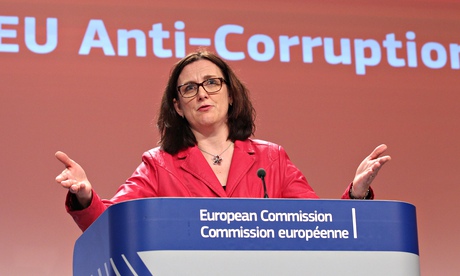
Corruption across the European Union’s 28 countries costs about 120 billion euros ($162 billion) per year — a “breathtaking” sum equal to the EU’s entire annual budget, EU Home Affairs Commissioner Cecilia Malmstroem said Monday.

But Germany gets top marks from the commission: “When it comes to fighting corruption, Germany is amongst the best countries of the EU.” But the country could benefit from introducing “strict penalties” on corrupt elected officials and “develop a policy” to limit the ability of government officials to go work for companies they previously were in a position to help.

Taxing Nuclear Fuel Rods That Aren’t Being Used?

You can never be too rich or too thin, I guess. And if you’re Germany, you can never tax too much, either.

Taxation

Germany’s biggest utilities, still reeling from the country’s early exit from nuclear power, scored a major victory Tuesday when a Hamburg court said the national tax on nuclear fuel rods may violate European law.

The Hamburg finance court said it “cannot assess beyond any doubt” whether the tax on nuclear fuel used for electricity generation complies with European law. It will now ask the European Court of Justice to decide whether the levy conforms with rules that prohibit member states from creating new taxes on electricity for “general budget financing purposes.”

The tax was introduced at the beginning of 2011 and came as part of an extension of nuclear reactors’ operating lives that the government had agreed on. However, the nuclear disaster at Japan’s Fukushima power plant in March of that year triggered a U-turn in German energy policy, with Chancellor Angela Merkel ordering the immediate shutdown of the oldest plants and the early phaseout of nuclear energy by 2022. Out of 17 reactors that were in operation in March 2011, only nine are still producing power. But the fuel-rod tax remains in place, to the utilities’ annoyance.

Das Hamburger Finanzgericht will vom Europäischen Gerichtshof (EuGH) in Luxemburg zentrale Fragen zur umstrittenen Brennelementesteuer klären lassen.

A Scrooge Issue?

Or is it more of a squanderer one?

Scrooge

I don’t know what troubles me more here; a Germany that spends too little for Christmas or the weakest European economies that spend too much.

With almost 28 percent unemployment and a lingering recession that’s wiped out one-fourth of their country’s economic output, it makes sense that Greek consumers plan to trim their Christmas spending by 12.8 percent this year. What’s more surprising is that the average Greek budget for holiday gifts, food, and drink is €451 ($608)—more than the €399 average in Germany, the country that has borne much of the cost of a Greek bailout.

Residents of Ireland, another bailed-out economy, plan to outspend the Germans more than two to one this Christmas, with an average €894 budget. In Spain, where unemployment is at 26 percent, consumers expect to spend an average €567. In recession-hobbled Italy, meanwhile, the figure is €477.

“Differences between countries’ spending habits are linked to the culture of the countries.”