They Used To Call It Inner Emigration

Now Germans do their inner emigration openly.

Exile

Peter Fitzek rules over a kingdom, and he has the passport to prove it. 

Bound in white, the passport gives Mr Fitzek’s name only as Peter I. His title is boldly stated: “King of Germany”. The issuing authority is the Kingdom of Germany, a pseudo-state founded by Mr Fitzek in 2012 that claims to have more than 250 citizens.

The kingdom is near the eastern German city of Wittenberg, and covers only a hectare. Mr Fitzek insists it meets all the criteria of an independent country, and that neither Germany’s law nor government hold sway within its borders. The kingdom has a flag and crest, a constitution and bank, a separate health insurance and pension system, and even a currency: the E-Mark…

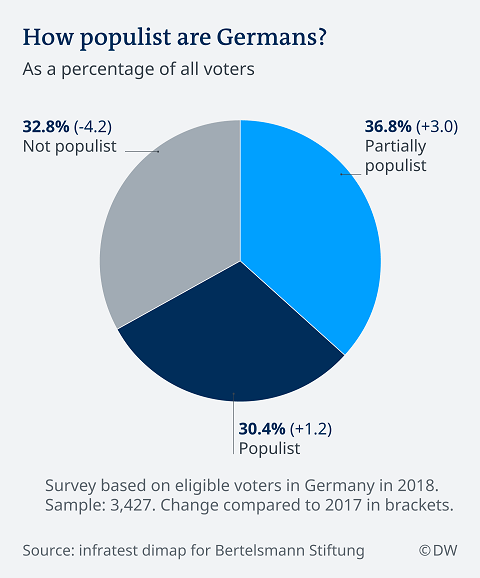
Political analysts argue that the movement, whose members are usually referred to as Reichsbürger (citizens of the Reich) or Selbstverwalter (self-administrators), is a symptom of the same political malaise that has fuelled the rise of the Alternative for Germany (AfD), the far-right party that won 13 per cent of the vote at last year’s general election.

“What you see is a deeply-rooted dissatisfaction that becomes so radical that people want to drop out of the federal republic altogether.”

German Of The Day: Fremdschämen

That means feeling shame on someone else’s behalf. You know, like for the SPD? The party you just left because you can’t take it anymore?

Fremdschämen

The SPD mayor of Freiberg just tossed in the towel and left the SPD. He had tried to get the party leadership to consider a four-year immigration stop for any new refugees in the hopes of stopping what he saw to be a shift in the public’s mood. He was ignored, of course.

Tired of them refusing to listen to what his constituents on the street in the real world have to say, he announced his departure from the party with a post on Facebook, noting that “if you look at what’s going on in Berlin these days the word “Fremdschämen” doesn’t even come close to how I feel about it.”

“Schaut man diese Tage nach Berlin, drückt das Wort ‚Fremdschämen‘ nicht einmal ansatzweise aus, was ich derzeit empfinde.“

Isn’t Anyone Going To Do Anything About This?

The great German beer crisis? Demand is falling, people. And I can only drink so much on my own.

Beer

Demand is falling in a country where there are more than 6,000 different brands of beer. The theory goes that you could drink a different one each day for more than 16 years without having to taste the same one twice. In fact, today fewer Germans regularly drink beer at all. Since the early 1990s, domestic consumption has dropped by more than a quarter. Consumption per head peaked in 1976 and has been falling ever since. The result has left mass-market brewers suffering from overcapacity and fighting a long-running price war. More than two-thirds of all the beer sold in supermarkets is offered at a discount.

“How is it that one of the world’s biggest export nations, and one so obsessed with beer quality, fails to woo international drinkers?”

Alien Crop Circle Discovered In Prackenbach

That’s in Germany.

AfD

Actually, it’s in Bavaria. But still.

And it’s not really an alien crop circle, either. It’s more like an alien cross. It’s a strange geometrical figure and ancient religious icon most likely stemming from the cultures of Eurasia where it remains a symbol of divinity and spirituality in Indian and East Asian religions, to be exact.

So I guess this crop circle didn’t come from outer space after all. It’s also made of manure. That, too, is pretty weird and strange. And the letters “AfD” are also clearly visible next to it. Nope, no alien would write those letters. Not even an illegal alien from outer space would do that, I suppose. This was the work of human beings. Human being artist types who use manure for their shitty works of art. This, too, is weird and strange. And eerie.

Aufregung in der kleinen niederbayerischen Gemeinde Prackenbach (knapp 3000 Einwohner)!

It’s Not Nice To Fool Mother Nature

Or fool with her, I should say. Aka The Empress of Europe. Aka Mutti.

Mother Nature

Get in the sack, Mr. Maasen. Come on, get in the sack. It’s time to sack you. You criticized my choice of words. You suggested I have a hand in Germany’s fake news industrial lying press complex. I don’t have a hand in it. I run the damned thing. It is time for you to go.

Rival political factions have been locked in a bitter war of words ever since Mr Maasen, the head of domestic intelligence service the Federal Office for the Protection of the Constitution (BfV) contradicted Mrs Merkel over the veracity of a video appearing to show foreigners being attacked on the streets on Chemnitz by neo-Nazi extremists.

Laut einem Bericht lässt Kanzlerin Merkel Verfassungsschutzchef Maaßen fallen – ohne Rücksicht auf dessen Chef Innenminister Seehofer.

German Of The Day: Sitzfleisch (vs. Aussitzen)

Take Angela Merkel. Please.

Merkel

To have Sitzfleisch (sitting meat) means, on the one hand, to be able to sit still for the long periods of time required to be truly productive; it means the stamina to work through a difficult situation and see a project through to the end. On the other hand, it can also refer to someone who doesn’t know when to leave. You know, like the guest who won’t go home or the chancellor who won’t go home, either?

Aussitzen (sitting something out), however, is to deal with a difficult situation or crisis by not doing anything about it. That is, to just wait it out until it finally goes away – or until the person waiting it out claims that it has gone away. You know, what Angela Merkel and other politicians like her regularly do?

“German condenses what would take about seven or eight words in English into one particular word. The humour comes from the density of the word and the fact that it expresses something in such condensed form that we can’t get anywhere near.”

Car No Longer Manufactured Since 2003 Will No Longer Be Manufactured Again Next Year

Feature

The compact Beetle was introduced in Germany in 1938 during the Nazi era before becoming a symbol of Germany’s rebirth as a democratic, industrial powerhouse after the second World War.

It came to the US 11 years later, where it became a symbol of utilitarian transport for the postwar baby boom generation – often used by hippies.

The famous car sold for about 30 years before US sales stopped in 1979, through production continued continued production for Mexico and Latin America. The last of the original bugs was produced in Puebla, Mexico, in 2003.

VW Käfer wird bereits seit 2003 nicht mehr hergestellt.

This Is Tree-Hugger Treason!

Or treeson, I should say. What? They’re already ready to give up after a mere six years and just… leaf?

Tree

German police confront treehouse activists after six-year standoff – Hundreds of police officers have descended on a patch of forest in western Germany occupied by activists living in treehouses, in an escalation of a long-running environmental battle.

Dozens of protesters have occupied 60 treehouses, some as high as 25 metres off the ground, since 2012 in an attempt to protect the ancient Hambach forest from being felled to make way for the expansion of an open-pit coalmine.

Why, I’m shocked. Wood you believe it? And they were doing such a treemendous job up there, too. What do they do now? Look for a new branch of work?

Polizei holt ersten Hambach-Aktivisten von Plattform.

Angela Merkel Condemns Xenophobia

After her decision to let more than a million refugees into Germany.

Bundestag

She hasn’t got around to condemning murder yet but she’s lernfähig (capable of learning), or at least she claims to be.

German Chancellor Angela Merkel condemned xenophobic attacks and the use of Nazi slogans in a robust speech to parliament on Wednesday after the most violent far-right demonstrations in decades exposed deep divisions in the country.

Protests of right-wing radicals in the eastern city of Chemnitz two weeks ago after the fatal stabbing of a German blamed on two migrants has reignited a fierce debate about her 2015 decision to let more than a million refugees into Germany.

Dann griff er Kanzlerin Merkel scharf an: Sie habe „Fake News“ verbreitet, als ihr Sprecher von „Hetzjagden“ gesprochen habe… „Verbarrikadieren Sie sich nur weiter im Bundeskanzleramt. Ich wiederhole meine Frage: Wer gefährdet den politischen Frieden?“

AI Don’t Trust You

But what’s new? Germans don’t trust any new technical development that comes along. Grundsätzlich (out of principle). New is scary because it always comes from somewhere else.

AI

So here’s another piece of news that made the news even though it’s not news at all: A YouGov survey has revealed that Germans are distrustful of anything that has to do with artificial intelligence. Not only is AI new (and from somehwere else), it’s, well, artificial. It’s not natural, you know? Non-organic or something.

Die Mehrheit der Deutschen steht einer Umfrage des Instituts YouGov zufolge dem Einsatz Künstlicher Intelligenz (KI) misstrauisch gegenüber. Nur rund jeder Siebte – 15 Prozent – denkt demnach, dass der Nutzen der Technologie gegenüber den Risiken überwiegt, wie die repräsentative Umfrage ergab.